
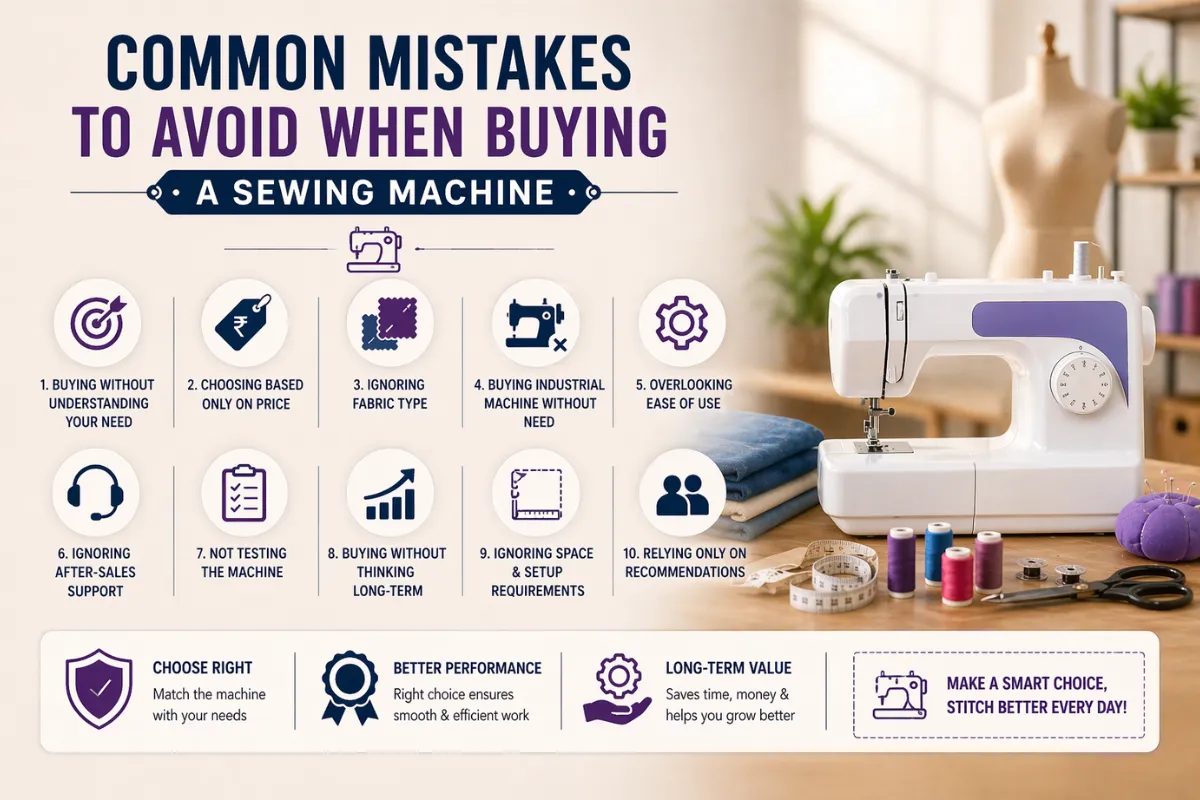
Common Mistakes to Avoid When Buying a Sewing Machine

Buying a sewing machine may seem like a simple decision at first.
You walk into a store, look at a few models, compare prices, and pick one that looks suitable. But many buyers realize later that the machine they chose doesn’t actually fit their needs.
The problem is not the machine.
The problem is the decision process.
A sewing machine is a long-term investment. Choosing the wrong one can affect your work quality, speed, and overall experience.
This guide will help you understand the most common mistakes people make—and how to avoid them.
Mistake 1: Buying Without Understanding Your Actual Need
This is the most common mistake.
Many buyers don’t clearly define:
- What they will stitch
- How often they will use the machine
- Whether it’s for home use or business
Without this clarity, it’s easy to pick the wrong type of machine.
✔ What You Should Do Instead
Start by identifying your usage:
- Occasional home stitching
- Regular tailoring work
- Heavy fabric handling
Your requirement should decide the machine—not the other way around.
Mistake 2: Choosing Based Only on Price
Price often becomes the main deciding factor.
Some buyers go for the cheapest option to save money.
Others assume a higher price means better performance.
Both approaches can lead to poor decisions.
✔ What You Should Do Instead
Focus on value, not just price.
A machine that fits your requirement will:
- Work efficiently
- Last longer
- Reduce repair issues
In the long run, the right machine saves more than it costs.
Mistake 3: Ignoring Fabric Type
Every sewing machine is designed for a specific range of fabrics.
Using the wrong machine for your fabric type can lead to:
- Uneven stitches
- Needle breakage
- Machine strain
✔ What You Should Do Instead
Always match the machine with your fabric:
- Light fabrics → Basic machines
- Medium fabrics → Standard machines
- Heavy fabrics → Heavy-duty or industrial machines
This is one of the most important decisions you will make.
Mistake 4: Buying an Industrial Machine Without Need
Many people assume industrial machines are always better.
But industrial machines are built for:
- High speed
- Continuous usage
- Professional environments
For home use, they can feel:
- Difficult to control
- Noisy
- Unnecessary
✔ What You Should Do Instead
Choose an industrial machine only if your work demands it.
Otherwise, a domestic machine is more practical.
Mistake 5: Overlooking Ease of Use
Some machines come with multiple features and complex settings.
While this may look attractive, it can slow you down if you are not familiar with them.
✔ What You Should Do Instead
Choose a machine that:
- Matches your skill level
- Is easy to operate
- Does not require constant adjustments
Simplicity often leads to better productivity.
Mistake 6: Ignoring After-Sales Support
A sewing machine is not a one-time purchase.
You may need support at different stages:
- Installation
- Maintenance
- Repairs
Many buyers overlook this and later struggle to find assistance.
✔ What You Should Do Instead
Buy from a dealer who provides:
- Basic guidance
- Service support
- Spare parts availability
Good support ensures a smoother experience.
Mistake 7: Not Testing the Machine
Some buyers finalize a machine without testing it.
This can lead to unexpected issues once you start using it.
✔ What You Should Do Instead
Always check:
- Stitch quality
- Machine smoothness
- Noise level
- Fabric handling
A short test can prevent long-term problems.
Mistake 8: Buying Without Thinking Long-Term
Your needs may grow over time.
A machine that works for you today may not be enough in the future.
✔ What You Should Do Instead
Think about:
- Future workload
- Business expansion
- Additional requirements
Choosing a slightly better machine today can save you from upgrading too soon.
Mistake 9: Ignoring Space and Setup Requirements
Industrial machines require:
- Fixed setup
- More space
- Stable working area
Not considering this can create inconvenience later.
✔ What You Should Do Instead
Check your available space and working environment before choosing the machine.
Mistake 10: Relying Only on Recommendations
Suggestions from friends or online sources can help, but they may not match your exact need.
✔ What You Should Do Instead
Use recommendations as guidance—but make your decision based on your own requirements.
Why Choosing the Right Dealer Makes a Difference
Even if you avoid all the above mistakes, your buying experience depends on where you buy.
A reliable dealer helps you:
- Understand your requirement
- Choose the right machine
- Avoid unnecessary confusion
This guidance becomes valuable, especially if you are new to sewing machines.
Final Thoughts
Buying a sewing machine is not about choosing the most popular or expensive model.
It’s about choosing the one that fits your work, your comfort, and your long-term needs.
When you avoid common mistakes, the process becomes much simpler.
You don’t just buy a machine—you make a decision that supports your work every day.
FAQ
The most common mistake is buying without understanding your actual requirement. This often leads to choosing the wrong type of machine.
Price is important, but it should not be the only factor. The machine should match your usage and deliver long-term value.
Most machines have limitations. It’s important to choose a machine that suits the type of fabrics you work with regularly.
Yes, testing helps you understand how the machine performs and whether it suits your comfort and work style.
Support ensures that you can maintain and repair your machine easily, which is essential for long-term usage.
Consider your current needs and future growth. Choose a machine that can handle increased workload and evolving requirements.