
Overlock vs Interlock Machine: What’s the Difference?

When people enter the tailoring or garment industry, one of the most confusing topics they face is understanding the difference between overlock and interlock machines. Both machines are widely used in tailoring shops, garment units, boutiques, and industrial sewing environments, but they serve different purposes.
Many beginners assume overlock and interlock machines are the same because both are used for garment finishing. In reality, they perform different stitching functions and are used in different stages of garment production.
Understanding these differences is important before investing in any sewing machine setup. Choosing the wrong machine can affect stitching quality, garment finishing, productivity, and overall workflow.
For tailoring businesses and garment users in Chennai, where stitching quality and finishing standards are highly important, knowing when and where to use overlock and interlock machines helps improve professional output significantly.
🧵 What is an Overlock Machine?
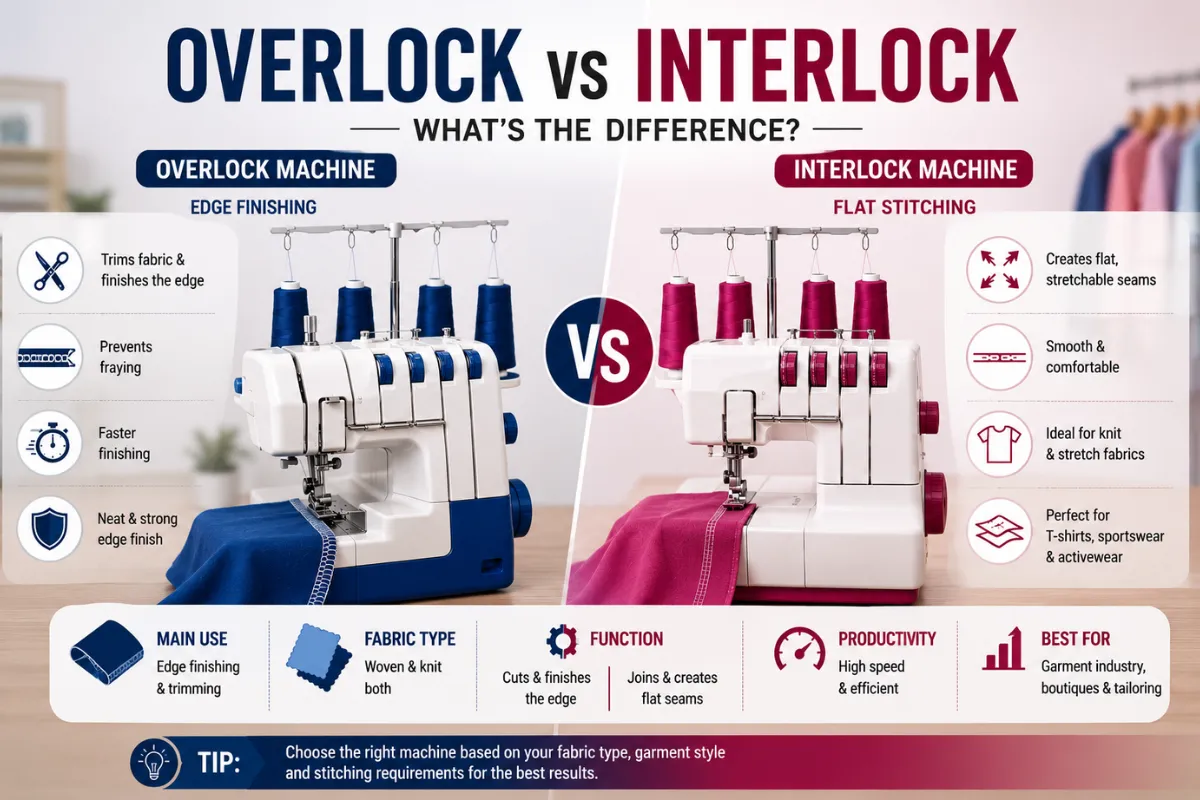
An overlock machine is designed mainly for edge finishing. It trims the fabric edge while simultaneously stitching around it to prevent fabric fraying.
This type of stitching creates a clean and professional edge finish that improves garment durability and appearance.
Overlock machines are widely used in:
- Tailoring shops
- Boutique setups
- Garment manufacturing
- Knitwear production
- Small-scale stitching businesses
The primary purpose of an overlock machine is not decorative stitching but fabric edge protection and finishing.
🧵 What is an Interlock Machine?
An interlock machine is designed for joining and finishing stretchable fabrics using flat and flexible stitching. It is commonly used in garment manufacturing, especially for knitwear and stretch garments.
Interlock stitching creates a smoother, flatter finish compared to overlock stitching.
These machines are commonly used for:
- T-shirt stitching
- Sportswear
- Leggings
- Innerwear
- Stretchable garment production
Interlock machines are especially important in modern garment production where comfort and flexibility are priorities.
🧵 Main Difference Between Overlock and Interlock Machines
The biggest difference lies in the purpose of stitching.
Overlock Machine:
- Primarily used for edge finishing
- Prevents fabric fraying
- Cuts and stitches simultaneously
Interlock Machine:
- Primarily used for joining stretch fabrics
- Creates flat, stretchable seams
- Focuses on garment comfort and flexibility
Although both machines contribute to garment finishing, they are used differently in production workflows.
🧵 How Overlock Stitching Works
Overlock machines use multiple threads and loopers to wrap thread around fabric edges.
The machine:
- Trims excess fabric
- Creates edge stitching simultaneously
- Produces neat seam finishing
This process improves:
- Garment durability
- Professional appearance
- Fabric edge strength
Overlock stitching is visible on the inside edges of many garments.
🧵 How Interlock Stitching Works
Interlock machines create flat and stretchable seams that allow fabric movement without damaging stitches.
The stitching:
- Remains flexible
- Feels comfortable against the skin
- Supports stretch fabrics effectively
This is why interlock machines are heavily used for:
- Knitwear
- Sports garments
- Casual wear
- Activewear
The focus is more on comfort and seam flexibility rather than edge trimming.
🧵 Key Features of Overlock Machines
⚙️ Edge Trimming
Cuts excess fabric while stitching.
⚙️ Fray Prevention
Protects fabric edges from loosening.
⚙️ Faster Finishing
Improves productivity in tailoring work.
⚙️ Professional Garment Finish
Creates clean internal garment appearance.
🧵 Key Features of Interlock Machines
⚙️ Stretchable Stitching
Ideal for flexible fabrics.
⚙️ Flat Seam Finish
Creates comfortable internal garment seams.
⚙️ Smooth Fabric Movement
Supports knit and elastic materials.
⚙️ Professional Knitwear Construction
Commonly used in T-shirt manufacturing.
🧵 Which Machine is Better for Tailoring Shops?
For regular tailoring shops, overlock machines are usually more essential because almost every garment requires edge finishing.
Blouses, salwars, uniforms, and other stitched garments benefit from overlock finishing.
Interlock machines become more important when the tailoring work involves:
- T-shirts
- Knitwear
- Stretch fabrics
- Sportswear
In many professional setups, both machines are used together because they perform different functions.
🧵 Which Machine is Better for Garment Businesses?
Garment businesses often require both machines depending on production type.
Overlock Machines are Essential For:
- Edge finishing
- Basic garment durability
- Woven fabric production
Interlock Machines are Essential For:
- Knitwear production
- Stretch garments
- Activewear manufacturing
Large garment units generally cannot depend on only one of these machines.
🧵 Which Machine is Better for Beginners?
For beginners entering tailoring, overlock machines are usually more practical initially because:
- They support general tailoring work
- They are useful across multiple garment types
- Edge finishing is widely required
Interlock machines are more specialized and often become necessary later depending on stitching specialization.
🧵 Common Mistakes People Make
❌ Assuming Both Machines Are the Same
Many users confuse their functions completely.
❌ Buying an Interlock Machine Too Early
Beginners may not actually need one initially.
❌ Ignoring Fabric Type
Stretch garments require different stitching behavior.
❌ Choosing Based Only on Price
Machine suitability matters more than low pricing.
🧵 Importance of Machine Selection Based on Work Type
The correct machine depends entirely on:
- Fabric category
- Garment type
- Production scale
- Stitching goals
For example:
- Boutique blouse stitching may require overlock support
- T-shirt manufacturing may require interlock stitching
Understanding workflow helps users avoid unnecessary investments.
🏬 Chennai Tailoring and Garment Industry Perspective
In Chennai, both overlock and interlock machines are widely used because the city has:
- Tailoring businesses
- Boutique culture
- Garment production units
- Knitwear demand
Many tailoring professionals initially invest in overlock machines and later expand into interlock systems as work grows.
Buying from trusted local sewing machine dealers helps users:
- Understand machine differences
- Choose suitable machine types
- Access servicing and spare support
- Avoid purchasing mistakes
This guidance becomes especially valuable for beginners and small businesses.
🧠 Do You Need Both Machines?
In many professional setups, yes.
Overlock Machines:
Used for finishing fabric edges.
Interlock Machines:
Used for stretchable seam construction.
Because they perform different tasks, both machines often work together in garment production environments.
However, smaller tailoring setups may begin with only overlock machines and expand later based on customer demand.
🎯 Final Thoughts
Overlock and interlock machines are both extremely important in tailoring and garment production, but they are designed for different purposes. Overlock machines focus on edge finishing and fabric protection, while interlock machines focus on stretchable seam construction and comfort.
There is no universally “better” machine between the two. The right choice depends entirely on:
- Your stitching goals
- Fabric category
- Garment type
- Production requirements
For users in Chennai entering tailoring, boutique work, or garment manufacturing, understanding these differences helps create more efficient and professional sewing setups.
Choosing the right machine at the right stage of growth can significantly improve stitching quality, productivity, and long-term business performance.
FAQ
Overlock machines are mainly used for edge finishing, while interlock machines are used for stretchable seam stitching.
Overlock machines are generally more essential for regular tailoring work because most garments require edge finishing.
No, interlock machines are used for many stretchable garments including sportswear and knitwear.
No, both machines perform different stitching functions and are used for different purposes.
Most beginners and small tailoring setups start with overlock machines first.
Because garment production often requires both edge finishing and stretchable seam construction.